Try it yourself
Six weeks in a small group, one night a week, learning the method the way it was built to be learned: by playing.
Explore Improv ClassesThe method
Functional Improv® is a method that uses the tools of improvisation to train the skills you use every day: listening, thinking on your feet, staying present, speaking up, and connecting with the person in front of you. It works the way functional fitness does, by rehearsing the movements real life keeps asking for. There is no stage, no audience, and nobody waiting on you to be funny on command.
If “improv” puts a Whose Line picture in your head, a spotlight and a buzzer and someone expected to be hilarious in four seconds, set it down. That is one narrow use of a much older toolkit.
It is improv, minus the pressure to perform.
Before improv was ever her job, Natalie spent over a decade as a personal trainer and coach. In that world, functional training is the opposite of isolating one muscle for show. It works the movements your body actually makes all day, lifting and reaching and balancing and carrying, so the training pays off somewhere other than the gym.
At some point it got obvious that our improv worked the same way. We were never training anyone to be a comedian. We were training the everyday movements of being human: the small, unglamorous reps that make a conversation, a first meeting, or a moment of real pressure go better than it otherwise would have.
So we named it Functional Improv®. And yes, we trademarked it.
The method found us before we found the name. We started in 2018 building this work for businesses, opened it up to everybody after 2020, and kept watching the same handful of skills do the same job in both kinds of rooms. The longer story of the two of us is worth a few minutes if you want it.
Games, plenty of them, and they get loud. Then just as often the room splits into pairs for an exercise or a straight conversation, where nobody is watching you because every other pair is busy with their own. A night bounces between the two. Either way, the game is never the point of the game.
After each one we stop and take it apart together. Where does that exact skill show up in your week? Not in theory: in the meeting you are quietly dreading, the conversation you keep rehearsing in the car, the moment somebody says something you did not see coming. You bring the real situations. The game gives you a rep at them. The debrief is where those two things meet, and it is the reason any of this transfers.
That debrief is the design, and it is the honest difference between this and a regular improv class. A regular class is building toward a show, and the last night is that show. Nothing here builds toward that. The last night of a Functional Improv® class looks like the first night, except everyone is looser and better at it.
Which is how people end up surprised. Someone signs up to get a little more comfortable speaking up, and a few weeks later they notice they interrupt less, recover faster when something goes sideways, and are having a better time at work. The workout is real. Almost nobody feels it happening.
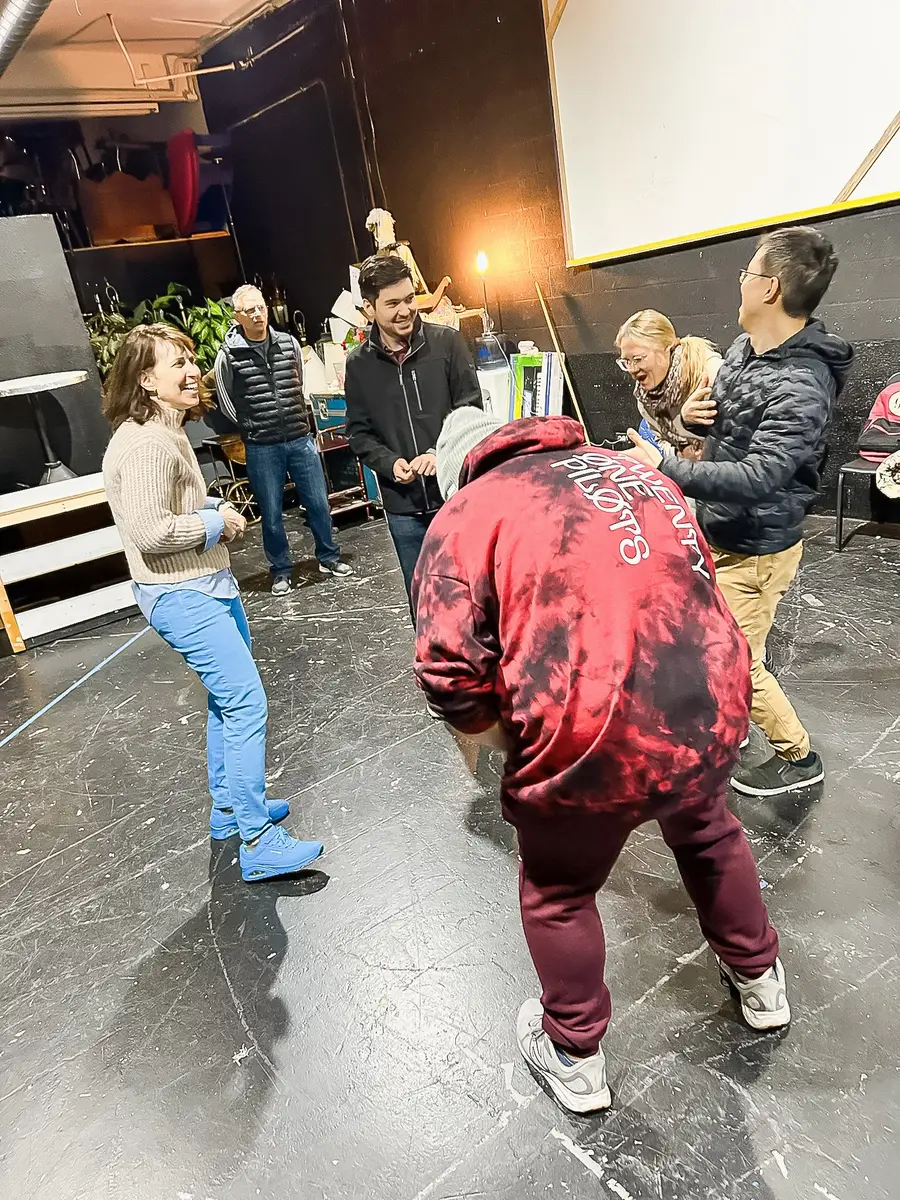
The skills are built into the games and the partner work, which is why almost nobody feels the workout. Named plainly, here is what a class is rehearsing.
None of it is mysterious. It is the ordinary principle behind any rehearsal: you get better at what you practice, and most adults have not deliberately practiced any of these since they were about nine.
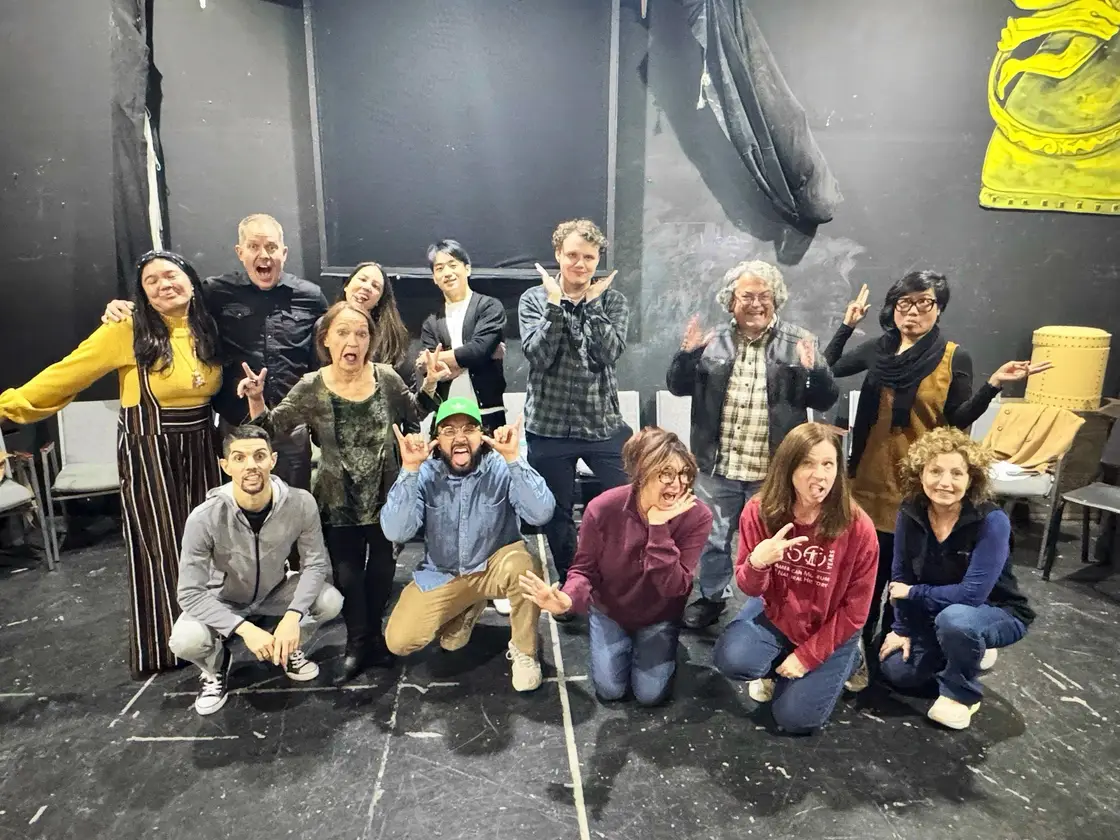
A wider range of people than you would guess, which turns out to be the most useful thing about it.
Overthinkers who live in their own head and would like to spend a little more time outside it. Introverts who decided years ago, usually on their own authority, that they are not the improv type. People rebuilding social muscles that got rusty while nobody was looking. And, just as often, people who simply like learning things, people who arrive already confident and want the next interesting thing, and people who came because a manager suggested it or a friend would not stop bringing it up.
On a given night that is a retired teacher, a software engineer, a nurse three days off a night shift, and somebody’s extremely game mother-in-law.
Whether you are picking a class for yourself or picking a way to get your team talking to each other again, the method underneath is the same one. Individuals take it as a six-week class; teams take it as a workshop built around their people.
Like Italian food, it is all in how you arrange it. The same ingredients underneath, a different meal depending on who is at the table.
Four six-week classes at Las Vegas Little Theatre, small groups, no set order and nothing to take first. Each one comes at the method from a different angle:
Start with whichever one names the thing you would like to be better at.
See the classes and what’s running nextEvery workshop gets built from scratch around what your people are actually working through, at whatever length and format the goal needs. Nothing is pulled off a shelf, because a room of engineers three weeks from a launch does not need the same session as a leadership team learning to disagree in public.
One of the two co-founders builds it and runs it, start to finish. The person who designed your session is the person standing in front of your team.
See how a workshop gets built for a teamRelated, but not identical. Applied improvisation is the broad field of using improv tools outside the theater, in workplaces, classrooms, and training rooms of every kind. Functional Improv® is the named methodology Vegas Improv Power built inside that field, organized around one parallel: functional fitness trains the movements your body actually makes, so Functional Improv® trains the movements a human actually makes with other humans. In practice that means a game, then a debrief that connects the game to the situations you brought in with you.
Plenty of good work happens across applied improv. The fitness parallel and the debrief structure are what make this version ours, and they are why the name is a registered trademark rather than a description.
See how the method runs as a six-week classNo. Quick wit is not the skill being trained, and it is not what the games reward. What they reward is listening, noticing what your partner actually said, and answering honestly instead of cleverly, which is why people who call themselves slow to speak often do the strongest work in the room. Wit turns out to be a byproduct of paying close attention rather than a requirement for showing up. Nobody keeps score on how sharp you are.
See what a six-week class actually coversNo, and that is the design rather than a compromise. There is no show at the end, no audience, no stage, and no moment where someone points at you and waits for a punchline.
A session is games and exercises, then the stop-and-debrief where the class works out where that exact skill shows up on a Tuesday. The skill is the deliverable, so it leaves the room with you.
If you do want to get on a stage someday, the foundation serves you well. It is simply not what we are building toward.
Read the longer story of the two people teaching itYes, and teams were the first rooms it was built for. Vegas Improv Power designs workshops around what a specific group is actually working through, whether that is a team that has stopped speaking up in meetings, a department merging with another, or a leadership group that wants better listening under pressure. Nothing is pulled off a shelf, so the session is shaped to the people in it rather than run from a script, and the length and format follow the goal rather than a package.
The method does not change for a corporate room. The arrangement does.
See Functional Improv® built for teamsIt’s Improv for Being a Human® - and it is exactly what it sounds like.
Six weeks in a small group, one night a week, learning the method the way it was built to be learned: by playing.
Explore Improv ClassesA workshop built around what your people are actually working through, aimed at how they talk to each other on Monday.
Plan a Team Workshop